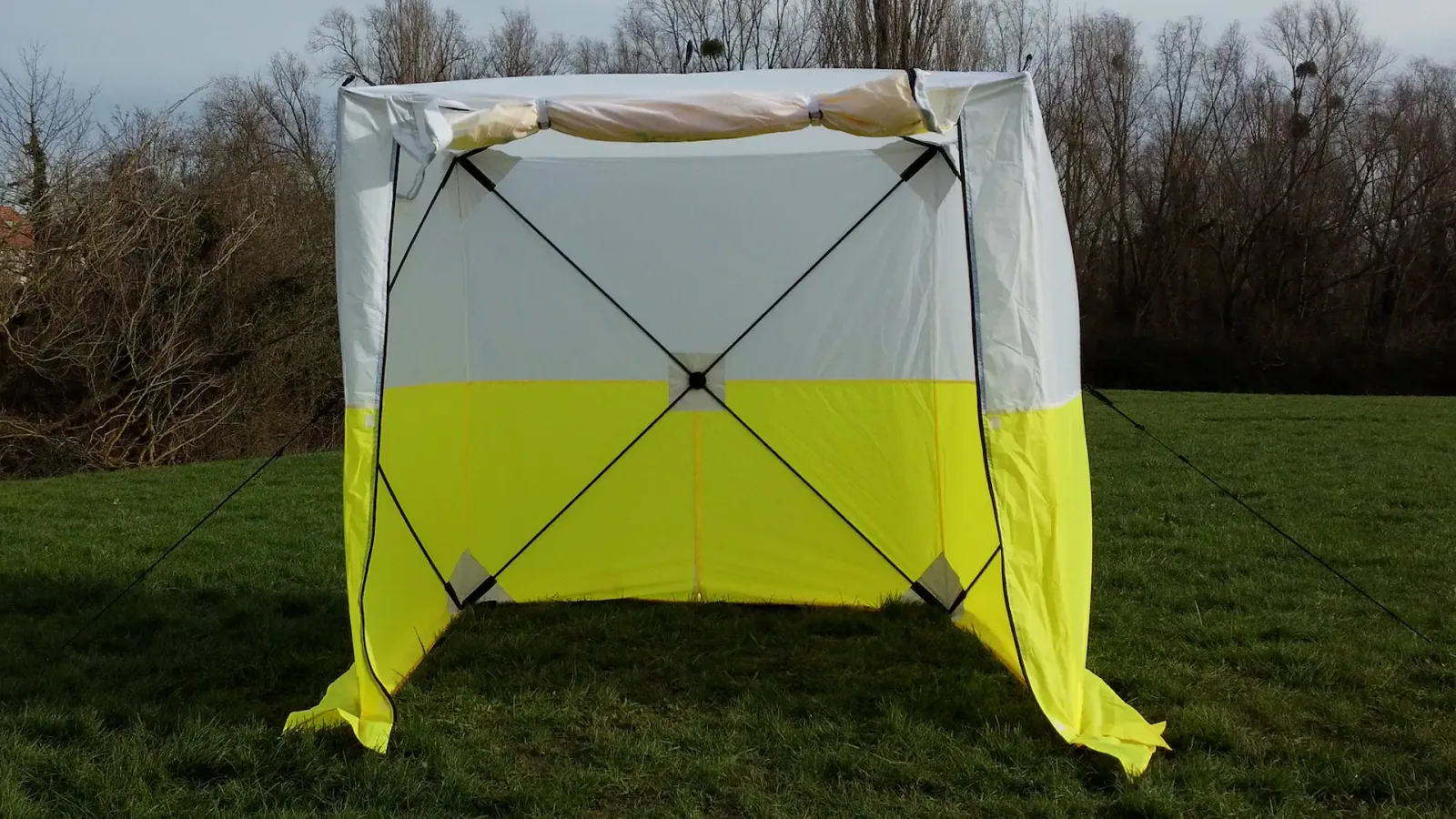
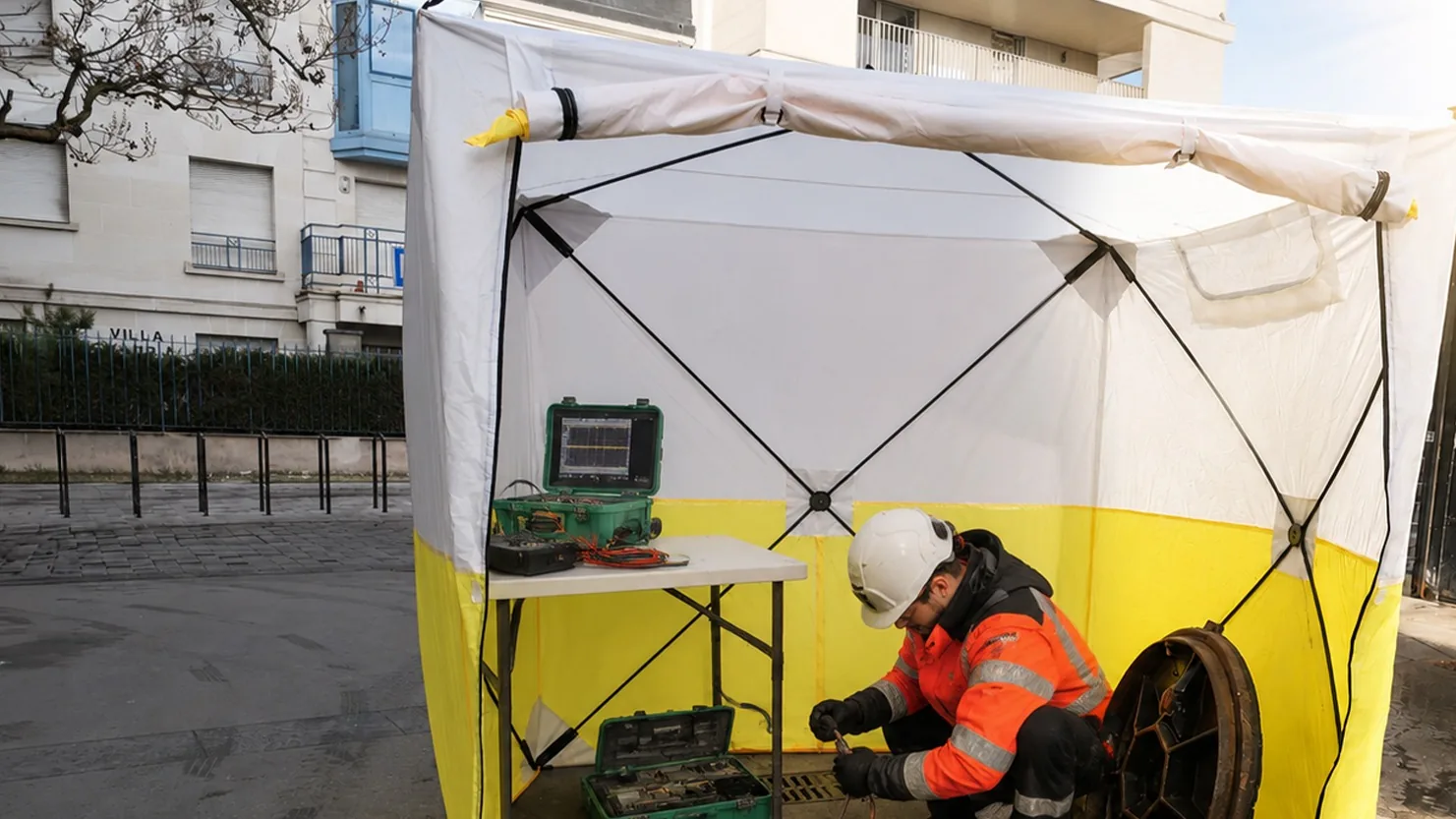
Most work tents come with ground stakes. On grass or packed dirt, those stakes do the job. On concrete, asphalt, loose gravel or a slab, they're useless: you can't drive them in, and you can't leave the tent unanchored. Weighing it down is the only alternative. Done right, it holds the tent as steady as staking does. Done wrong, it gives you a false sense of security, and the tent goes over at the first gust.
Why hard ground changes everything
A stake driven into the ground holds by friction along its whole length: that friction is what keeps the anchor in place. On hard ground, it's gone. Even a stake laid flat slides when the tent pulls on it.
A work tent puts a lot of surface into the wind. On an open site, on high ground or along a road, the wind can be stronger than forecast. An unsecured tent can slam into equipment, hit someone or end up in the roadway. Ballast deals with this by swapping the anchor in the ground for downward weight: if the tent tries to lift, the weight holds it down.
The four common options
There's no one-size-fits-all answer. The right choice depends on what you have on hand, the vehicle you haul the tent in and how long the job lasts.
Sandbags. This is the classic option on construction sites. A standard sandbag, available at any building supply store, slides into the foot loop or lies flat on the foot plate. The main advantage: you can adjust the weight by adding or removing sand as conditions change. The downside: bags tear, sand spills across the site, and they're bulky to haul when full.
Concrete ballast blocks. Some tent legs are designed to take precast blocks: road barrier blocks, low bollards, parking stops fitted with a ring. They're stable and nearly indestructible. They suit long jobs or semi-permanent setups. On the other hand, their weight makes them hard to handle alone.
Water-filled ballast. These hard plastic tanks travel empty and get filled on site with a hose or a water jug. Once full, they give you solid weight for very little room in the truck. Two things to watch: below freezing (32°F, 0°C), the water freezes and can crack the tank, and some models aren't fully sealed, so they slowly lose weight over the course of the day.
Tying off to an existing fixed point. On some sites, you can tie one or more corners of the tent to something already in place: a guardrail, a proper job site barrier, a fence anchor. Strictly speaking, that's not ballast but a direct tie-off to a solid structure. It only works if the anchor point can take the pull and the strap doesn't damage whatever it's attached to.
Spread the weight correctly
The first mistake is weighting only the side facing the wind. If the wind shifts during the day, the weight ends up on the wrong side. A properly anchored tent is weighted evenly on all four legs.
The second mistake is setting the weight next to the leg instead of on it. A sandbag sitting away from the foot plate holds nothing, because it isn't connected to the tent. The weight has to sit directly on top of the foot plate, or be strapped to it through a hook or ring made for the purpose.
Some tent legs have a flat foot plate designed to take a block on top. Others have a built-in ring to hang a bag from. Others still have a hollow tube you can slide a weight bar into. Check how your model is built before you pick a method: the wrong attachment can be as useless as no attachment at all.
Combine weights and guy ropes
Weights and guy ropes don't do the same job. Weights hold the tent down against the wind's uplift. Guy ropes keep the frame from being pushed out of shape sideways, holding the legs spread. The two work together; one can't stand in for the other.
On hard ground, guy ropes run into the same problem as stakes: they need an anchor point on the ground. You have a few options:
- A freestanding ballast plate: a heavy rubber or cast-iron block with a built-in guy rope ring, set on the ground with nothing to fasten.
- Tying off to a job site barrier or fence, if it's strong enough and the angles work.
- Concrete anchors, if the job is long and the surface can be drilled (clear it with the client or general contractor first).
In calm to moderate wind, solid weight on all four legs is enough in most situations. In sustained wind, or when gusts are in the forecast, guy ropes become essential. Either way, turn the tent's opening crosswise to the prevailing wind, or away from it: it catches a lot less wind that way, which takes that much load off the ballast.
What not to do
Improvising with whatever is lying around the site. A cinder block balanced on a foot plate can slide off and fall. An open bucket of water tips over the first time someone bumps it. A pallet laid across the legs holds nothing unless it's strapped to the tent: it can slide sideways without putting up any downward resistance.
Underestimating how much weight you need. The bigger the tent, the more surface it puts into the wind, and the heavier the ballast has to be. If you're not sure you have enough, add more: too much weight does no harm, too little can.
Forgetting to check after setup. A water ballast can leak slowly, and a sandbag can shift if someone kicks it walking by. Make a habit of checking the anchoring around midday, especially when the weather is changing.
Practical tip
On asphalt or smooth concrete, the foot plates can slide sideways even when the tent is well weighted. Check that the feet have rubber pads or a non-slip surface: that small detail prevents a kind of tip-over that has nothing to do with lifting, and that people often overlook.
The bottom line
On hard ground, the stakes that come with the tent can't be used. Done right, ballast gives you the same stability: sandbags, concrete blocks, water ballast or a tie-off to a fixed point, each method has its own conditions of use. What matters is weighting all four legs evenly, making sure the weight actually sits on the foot plate, and adding guy ropes when the wind calls for it. Well-planned anchoring takes a few minutes to set up and prevents incidents that can shut down a full day of work.

JAX3 Work Tent
Sets up in about 60 seconds · Comes with 4 heavy-duty stakes and guy ropes · About 19 lbs, carry bag included